
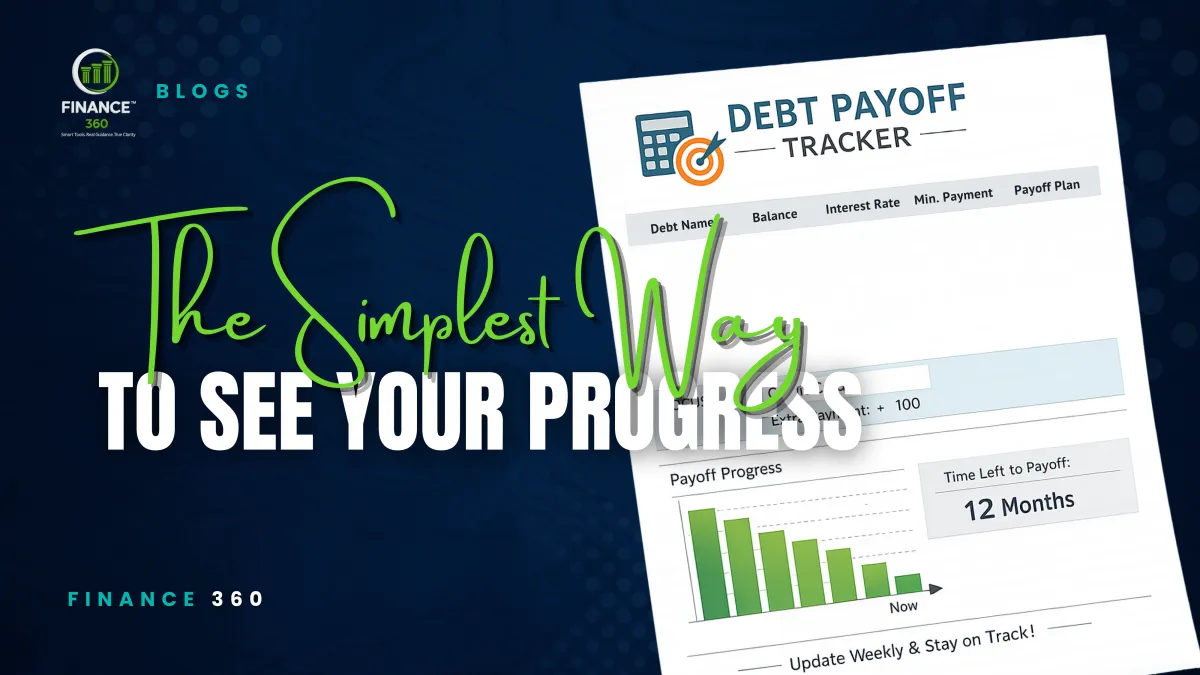
Debt Payoff Tracker: The Simplest Way to See Your Progress | Finance 360
Debt payoff can feel like you are doing all the right things and still going nowhere. You make the payment, you skip a few extras, you try to stay disciplined, then you check your balance and feel your motivation slide. When progress feels invisible, it is easy to drift back into “I’ll deal with it later.”
A debt payoff tracker solves that specific problem. It turns your payoff journey into something you can actually see, week to week, payment to payment. Once you can see your numbers clearly, the next steps get way easier. Here’s how to build that clarity.
Debt payoff feels slow even when you are paying
Most people expect the balance to drop in a clean, satisfying way. Real life does not cooperate. Interest, timing, and minimum payments can make your effort look smaller than it is, especially if you are paying across multiple debts and your budget has zero breathing room.
It also helps to know this is not a “you” problem. Household debt in the U.S. is massive right now, and many families are trying to make progress while costs stay high. The New York Fed reported total household debt reached $18.8 trillion in Q4 2025, and credit card balances were around $1.3 trillion. When the baseline pressure is that heavy, slow progress is common, even for people who are trying hard. (Source: Federal Reserve Bank of New York)
That is exactly why a tracker matters. It gives you a reality check that keeps you steady, because you can see the progress that your feelings are missing.
What a debt payoff tracker should show
A debt payoff tracker is a simple scoreboard. At minimum, it should show your current balance, your interest rate, your minimum payment, and your monthly payoff plan for each debt. If your tracker only shows the balance, it still helps, but you miss the part that drives smarter decisions: how interest and payment size change the timeline.
This is where a tracker becomes motivating. When you see how long the payoff takes at the minimum payment, you start understanding why the balance feels stubborn. You also start seeing how even a small extra payment can matter, because it shortens the timeline and cuts interest.
That “small extra payment” mindset is important because carrying balances is still extremely common. Bankrate reports that 47% of American credit cardholders carry a balance as of December 2025. That tells you a lot of people are living in the monthly interest cycle, which is exactly what a payoff tracker helps you break by making the true cost visible. (Source: Bankrate)
Once you know what to track, the next step is setting it up in a way you will actually keep up with.
Set up your tracker in 15 minutes
Step 1 is your snapshot. Pull your latest statements and record your balance, APR, minimum payment, and due date for each debt. Keep the numbers exact. The goal is to see the truth clearly, because “close enough” numbers make it easier to avoid the plan later.
Step 2 is your attack plan. Pick one method and stick with it for at least 90 days so your tracker reflects a real pattern. If you want motivation, target the smallest balance first. If you want to reduce interest costs faster, target the highest APR first. Either way, your tracker should highlight one “focus debt” that gets any extra amount you can afford.
Step 3 is your weekly rhythm. Update it once a week, on the same day, and keep it short. You are looking for direction, not perfection. This is also the moment to include debts people forget because they do not feel like “real debt,” like buy now, pay later plans that quietly stack up. The Richmond Fed estimated total BNPL transaction value was about $70 billion in 2025, which shows how common it has become. If you want a complete progress picture, your tracker should include BNPL so you stop underestimating your monthly commitments. (Source: Federal Reserve Bank of Richmond)
Once the tracker is part of your week, the biggest win is what happens next: your decisions start getting cleaner without you needing a pep talk.
Make your progress visible, then get support when you need it
A debt payoff tracker works because it keeps you honest and encouraged at the same time. You stop guessing. You stop relying on motivation. You start relying on a simple routine that shows proof of progress, even in slow months.
If you want to make tracking easier, start by using the Finance 360 app experience first, then connect with support. Download the mobile app for iOS or Android, or use the web version. If you want to speak with a debt specialist, schedule through the Debt Management page here. For more practical guides like this, visit the Finance 360 Blog Hub.
Start your financial journey today with Finance 360!


